
Tokenized Securities
What the heck are they?

I posted a thread on X describing the DTCC’s proposal to “tokenize” its DTC-custodied assets. In case you missed it, I reproduce the thread here.
***
[1/10] This headline caught my attention. What does “tokenization” actually entail?
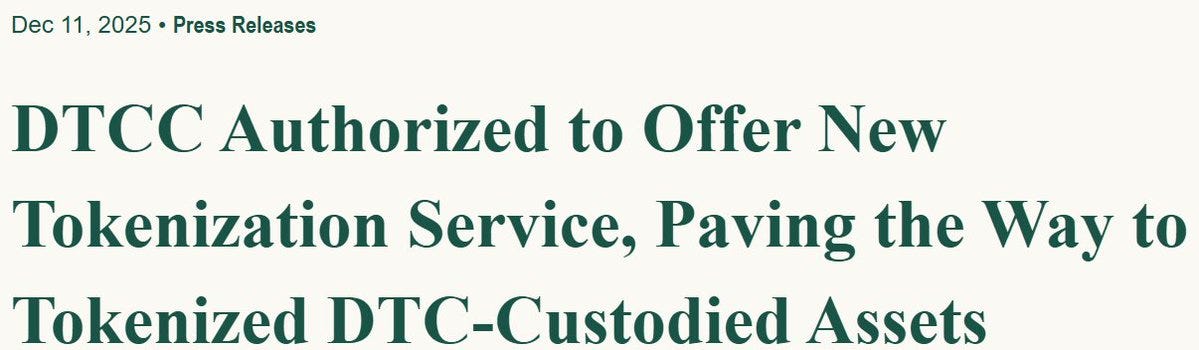
[2/10] My recollection is that in crypto culture, “token” often implied: (1) direct bearer ownership; (2) self-custody; (3) peer-to-peer transfer; and (4) decentralization. At least, this was my understanding when I wrote on the idea here: andolfatto.blogspot.com/2018/11/smart-…
[3/10] But this is not at all what “tokenization” means in institutional finance. In that context, the term means something more like “standardized programmable entries on coordinated ledgers.”
[4/10] So, what’s going on? The DTCC, which maintains the master plumbing of U.S. securities settlement, announced plans to “tokenize” a large subset of DTC-custodied assets, including Russell 1000 equities, major ETFs, and U.S. Treasuries.
[5/10] At first, I thought the idea was to transform custodied assets into digital bearer securities, like USDC tokens. That would be illegal though (the GENIUS Act only permits stablecoins to issue digital bearer instruments).
[6/10] The idea, instead, is simply to represent ownership claims as standardized programmable digital objects on a shared ledger. Is this “blockchain?” You still have custodians, transfer agents, centralized registries, legal intermediaries, regulated ownership records, etc.
[7/10] Even if DTCC has its own master database, many other parties maintain separate ledgers: custodians, broker-dealers, clearing members, exchanges, asset managers, collateral systems. Evidently, a huge amount of finance consists of reconciliation across databases.
[8/10] The idea of a “tokenized security” is in representing a security as a digital object on a shared ledger for the purpose of creating a shared canonical state across the institutions listed above.
[9/10] In addition to reducing reconciliation costs, tokenization could improve performance in terms of programmability, final settlement speed, and collateral efficiency.
[10/10] Ironically, this is not about DeFi replacing Wall Street. It is closer to Wall Street adopting DeFi-inspired protocols—minus the decentralization—to eat DeFi’s lunch! 🤓